A Forgotten Confrontation
World War III, but in 1999…

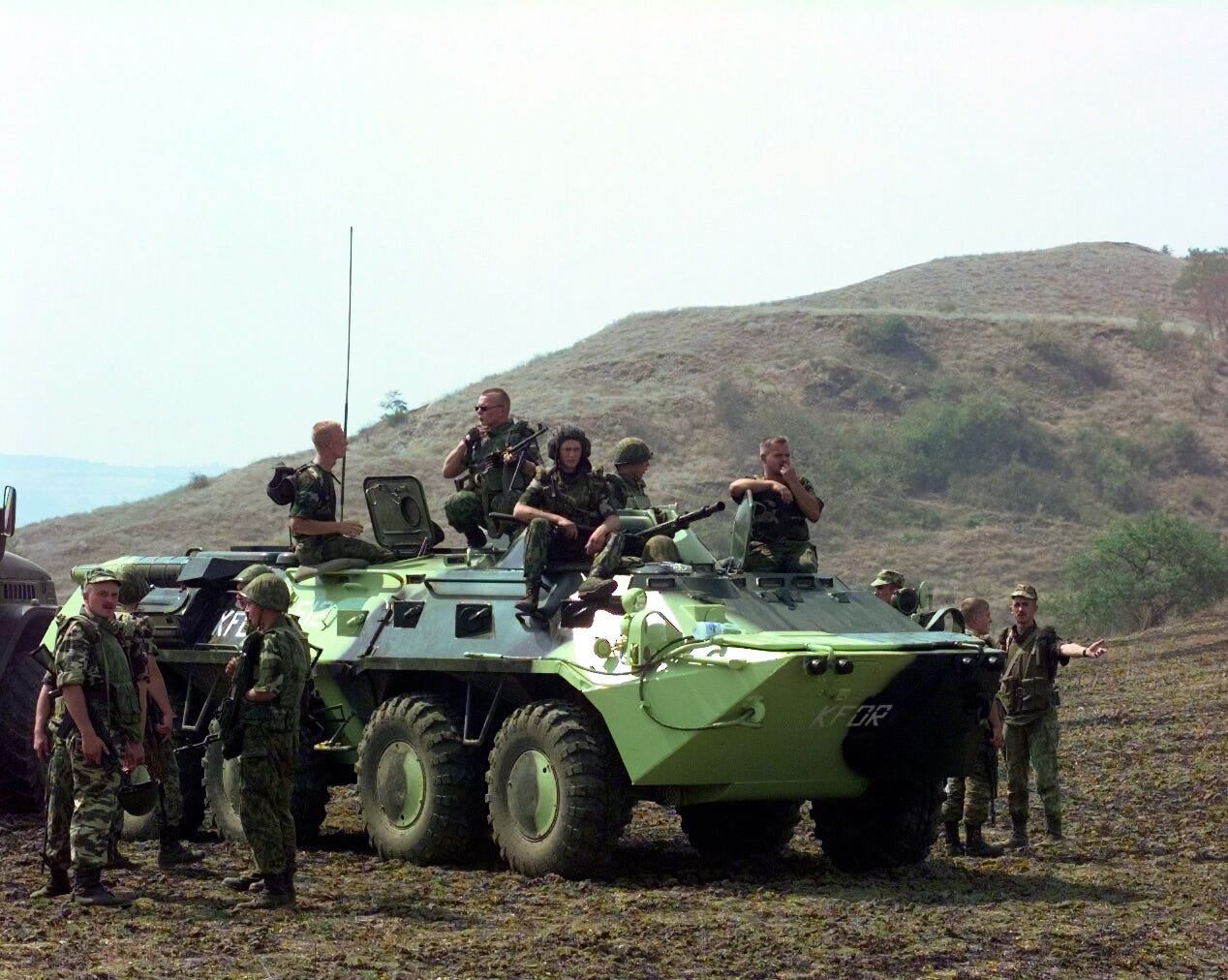
With the end of the Cold War in 1991, many hoped a new relationship could be forged between the former USSR and the Western powers. President Clinton and Yeltsin would shake hands and toast to the future of US-Russian relations. It was thought that the US and the West at large could work with a newly democratic Russia on pressing global issues: arms control, terrorism, and organized crime. But unfortunately, history had other plans. In June 1999, a semi-forgotten piece of post-Cold War history occurred. It would happen in the freshly war-torn Balkans, specifically the then soon-to-be independent nation of Kosovo. At the local international airport, in the city of Pristina, NATO and Russian forces would confront one another in a sign of what was to come in the decades that followed. And what made this particular confrontation even more tense was that NATO forces were under orders to “overpower” the Russian forces that had occupied the airport.
As Yugoslavia tore itself apart through the 80s and into the 90s, Russia would sit on the sidelines. Russia, preoccupied with internal divisions and the impending dissolution of the USSR, would be unable to assert its influence in a region it once regarded as a dominant power. In addition, Russia would be unable to render economic aid due to the ongoing economic “shock therapy” being applied at the time. Russia, historically considered the defender of the Slavs in the area and more specifically those of Serbia, observed NATO intervention with suspicion. But by early 1999, as NATO forces continued to operate in the region, specifically US forces, Russia would be compelled to act. Of course, Moscow would need to deal with a headache by the name of Slobodan Milošević. While the Russian government was generally supportive of Serbian activities but was wary of being drawn into a new Balkan War. In the end, Moscow threw caution to the wind and decided to deploy its forces ahead of NATO’s coming peacekeeping force. But with Russia failing to communicate its intent to deploy forces, as a Russian request for an independent Russian peacekeeping force in Kosovo had been refused by NATO, Moscow felt that it was time to act. A small armed convoy of Russian forces would rumble away from their forward positions in Bosnia towards a near miss of catastrophe.
On the morning of June 11th, about 250 Russian soldiers would dismount their vehicles and seize the Pristina International Airport. It would only be a few hours later that SHAPE (Supreme Headquarters Allied Powers Europe) would be made aware of this. General Wesley Clark had planned to deploy British and French paratroops to the airport, but not for a few more days, per the peace agreement with Serbia. The Russians had jumped the gun and got their first. It was then decided to move up the timetable, and British and Norwegian forces started moving into Kosovo the next morning, June 12th. This contingent was led by British Captain James Blunt. The first elements of this force that came into contact with the Russian soldiers were British SAS and Norwegian FSK. British General Mike Jackson was the overall commander of this force and soon met with his opposite, General Viktor Zavarzin. The situation, at that moment, seemed to calm. But NATO command was concerned that additional Russian forces were to be deployed. This fear was not unfounded, as the Russians had prepared airborne battalions to be flown to the airport. It was around this time that Gen. Clark planned to send an order to British forces, having them physically block the runway with their helicopters. But by the evening, poor weather had taken hold, which rendered the Russian reinforcement plan and Clark’s blocking plan moot. But Clark would not be deterred. On Sunday, June 13th, he would claim that he had the authority of the NATO Secretary-General and would send additional orders for the runway to be blocked. Later, General Clark would sharpen his orders to British Captain James Blunt, saying he needed to “overpower” and “destroy” the Russian forces at the airport. Captain Blunt refused the orders and stalled by asking for further clarification. Clark charged tactics by going over Blunt’s head to General Jackson, who infamously replied, “I’m not going to start the Third World War for you.” That was the high point of tensions.
But Clark would persist, which forced General Jackson to threaten to tender his resignation. Instead, the British government intervened and offered to have a separate force, the 4th Armored Brigade, to surround and isolate the airport. Additionally, the US government could apply pressure to the governments of Bulgaria, Hungary, and Romania to close their airspace to any incoming Russian aircraft. Over the course of 72 hours, the situation would resolve. Russian forces would remain in the area as peacekeepers, but only for a limited amount of time; later, the airport would be operated by British forces. But the Russians were effective in getting their seat at the table when it came to post-war Yugoslavia. The gambit was a bold one: rush to the main airport in the area and beat NATO forces to the punch. Russian peacekeeping forces would stay in the area until 2003. In the end, NATO backed down, specifically General Wesley Clark. NATO-Russia relations would sputter on.
What was once seen as a brief hiccup in otherwise blossoming East-West relations can now be seen in retrospect as a precursor of events to come. Although it would take about another decade for relations to enter a true “chill”, 1999 can now be seen for what it really was. The US, NATO, and the West more broadly found out the limits of what the “new” Russia was willing to tolerate. Two revolutions, two world wars, and civil war weren’t going to change Russia’s attitude towards Serbia, the Balkans, or its near-abroad generally. On the other hand, NATO and the West seemed surprised that Russia would be such a vocal supporter of a war criminal like Milošević and his crimes. The old Russia/USSR made a small cameo in 1999, at least from the perspective of NATO. But it can now be more accurately seen as a flash-forward of sorts, a pre-Putin Putin’s Russia. On the whole, both sides found out that there might be some issues where common ground might be scarce. A small nervous chill went down the spines of those in Washington and Moscow, maybe things weren’t going weren’t going go so well? But soon 9/11 would happen, and Bush and Putin would embrace and pledge to fight radical Islam together. And Europe would be left alone…
https://balkaninsight.com/2024/06/12/british-brigadier-recalls-world-war-three-moment-in-kosovo/btj/
https://www.independent.co.uk/news/people/news/how-james-blunt-saved-us-from-world-war-3-2134203.html
https://www.theguardian.com/world/1999/jun/13/balkans5
What would the world look like today if Jackson had said yes? 'I'm not going to start the Third World War for you' might be the most consequential sentence spoken by a general since 1945
An interesting reminder that the post-Cold War order was never as stable as many assumed. The Pristina airport episode already showed that Russia still viewed the Balkans through a strategic lens, even during the Yeltsin years. In hindsight it feels less like an anomaly and more like an early signal that the “partnership era” between NATO and Russia had clear limits.