
Borrowed Pasts, Invented Futures
Forming a national identity in Central Asia

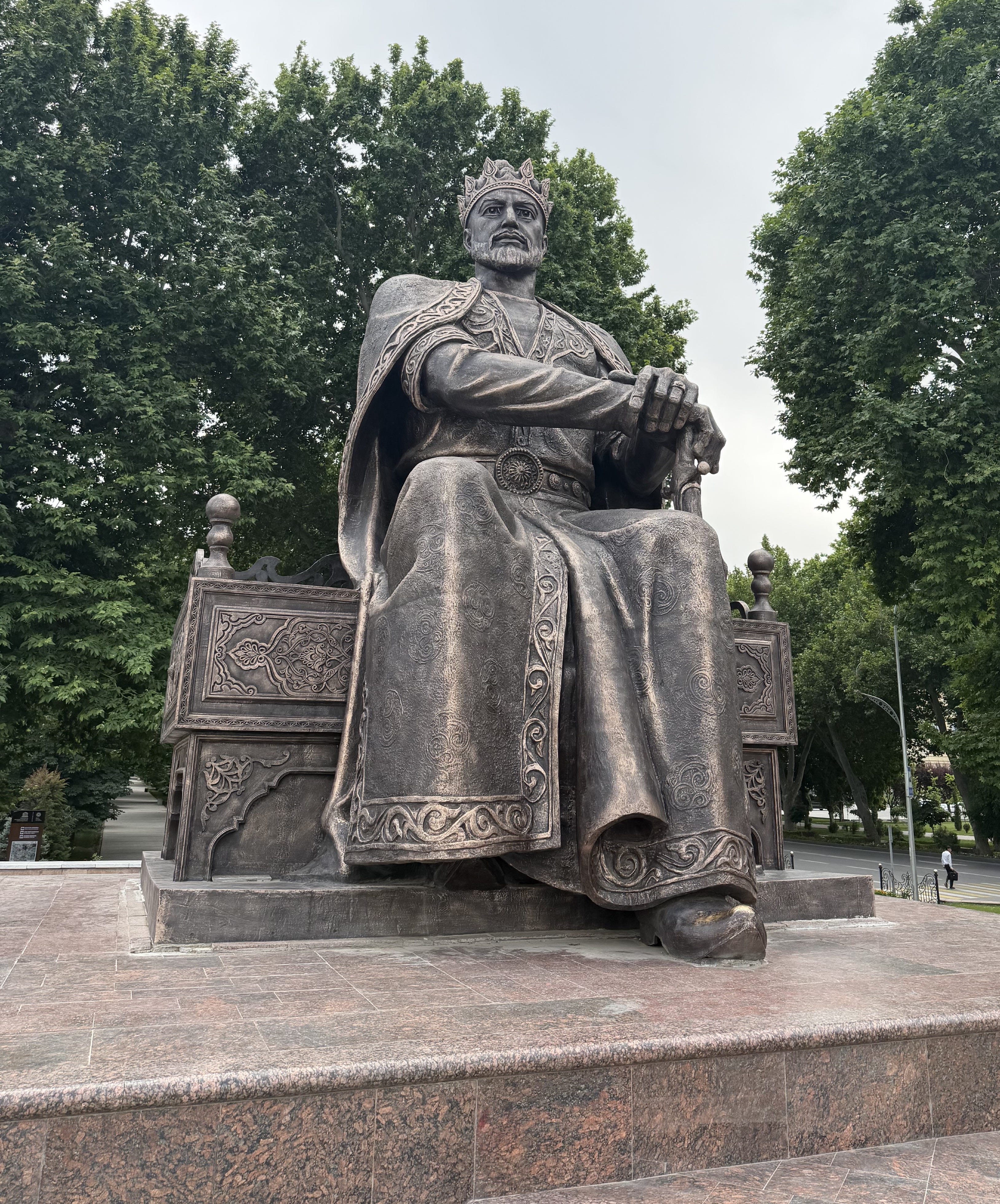
A statue of Amir Timur, Tamerlane to those in the West, stands at a roundabout on University Drive in Samarkand, Uzbekistan. It’s large and imposing, embodying the man it’s meant to honor. It’s also serving to create a sense of national identity in a nation-state that I myself am older than. About 600 miles to the west lies the capital city of Turkmenistan, Ashgabat, famous for its white marble buildings. In addition, gold-accented monuments dot its landscape, and again, they are large and imposing. But here they serve a different purpose. Independence Park, the Arch of Neutrality, and a giant copy of the Ruhnama (a book on spiritualism written by Turkmenistan’s first president) speak almost exclusively to Turkmenistan’s brief post-independence history. Monuments, like the ones listed above, speak to the very paths taken by both nations.
Both nation-states were born out of the tumultuous 90s. Uzbekistan was quick to declare national sovereignty in June 1990, but wouldn’t be able to declare full independence until August 31st, 1991, in the direct aftermath of the August coup attempt in Moscow. Turkmenistan would also declare national sovereignty in August 1990, but full independence wouldn’t come until October 27th 1991. It’s known that the future leader of Turkmenistan, Saparmurat Niyazov, retained support for the continuation of the USSR, hence the later date of full independence. This would also come to affect the trajectory of the newly born state. Both nations would become independent around the same time. Both would carry their Soviet-era leadership into independence; the same men who had served Moscow would now present themselves as fathers of newly sovereign nations. In addition, both would come to be heavily reliant on commodities, as they had in their Soviet period: cotton and agriculture for Uzbekistan and gas for Turkmenistan. But these paths would start to diverge when it came to the question of the Russian/Soviet legacy in their respective nation-states. Islam Karimov would attempt to forge a new nation based on a slightly romanticized version of Uzbekistan’s past. While Niyazov in Turkmenistan wished to recapture a bit of the Soviet past, but still rooted the national identity in a vision of a “Turkmen future”.
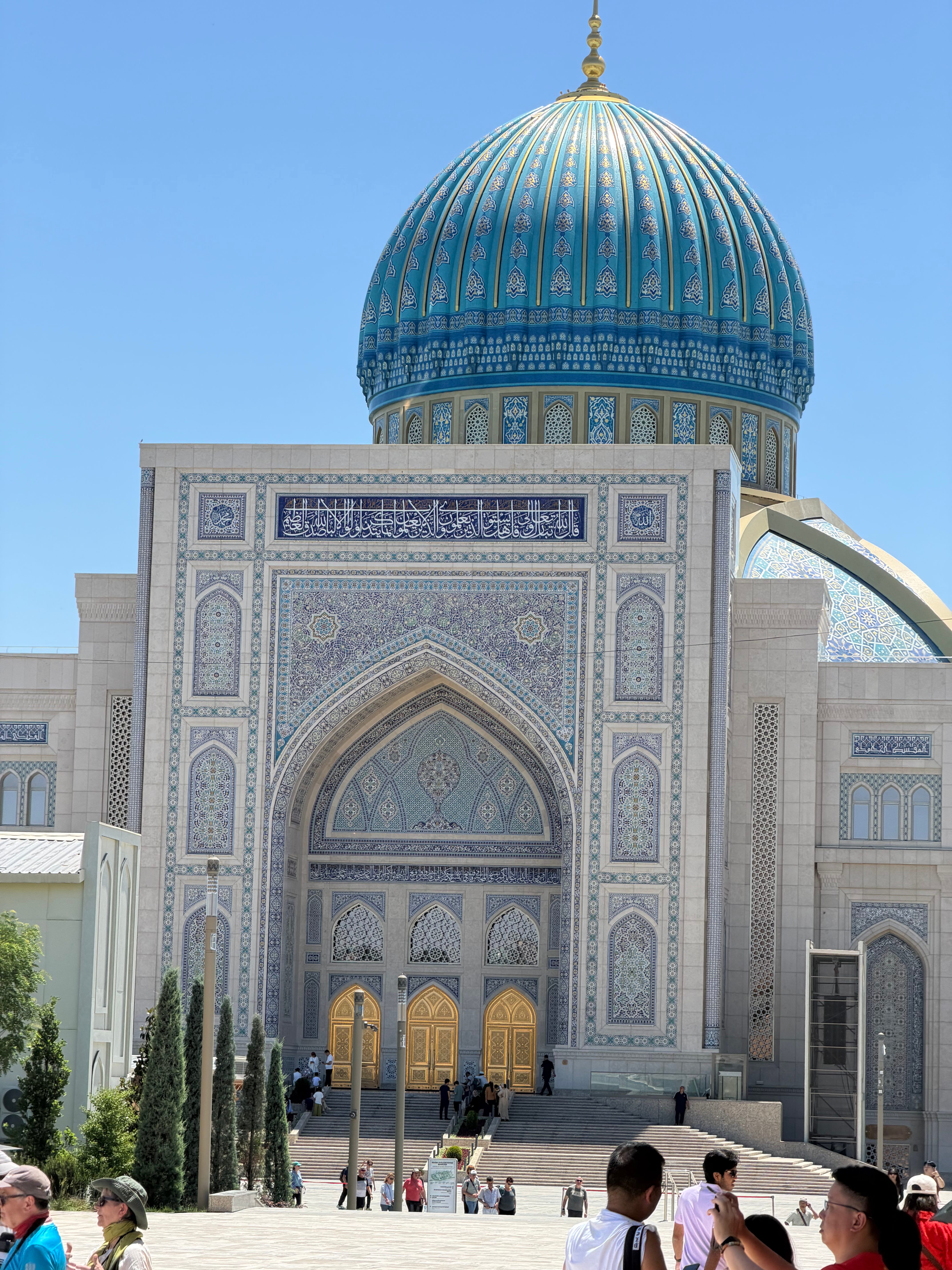
Islam Karimov would rule Uzbekistan from its independence in 1991 till his death in 2016. It wouldn’t be long after independence that he would set about building the new nation’s identity, mainly relying on its pre-Soviet history. Historical figures like Amir Timur and his grandson, Ulugh Beg, an astronomer and mathematician, would come to feature prominently in monuments across the nation. The statue I mentioned in Samarkand was built in 1994. This would go along with Amir Timur Square in Tashkent, the new capital, also in 1994. Later in 1996, the Amir Timur Museum would be built. There is some irony in Amir Timur being used as a national hero symbol; the Uzbek national identity was still hundreds of years away from creation, and from all the evidence we have, Timur himself was of Turkic and Mongol ancestry. Timurid-style architecture would come to be a signature of the post-independence period when it comes to museums and other landmarks. The recently completed Center of Islamic Civilization in Tashkent was constructed to embody this style, as it sits next to the much older Hazrati Imam Complex. Even in smaller cities like Bukhara and Khiva, the Uzbek government has seen fit to create cultural legacies. Khiva, the old city specifically, has been turned into an open-air museum, complete with residents calling the area home and working shops and restaurants. Although residents are prohibited from making any structural modifications to their residence. Another theme running through all monuments and museums is the connection to the old Silk Road and its importance in the ancient world. Our tour group had been informed that in Khiva, older statues at the entrance of the old city area had been recently replaced with a Silk Road-style caravan piece.
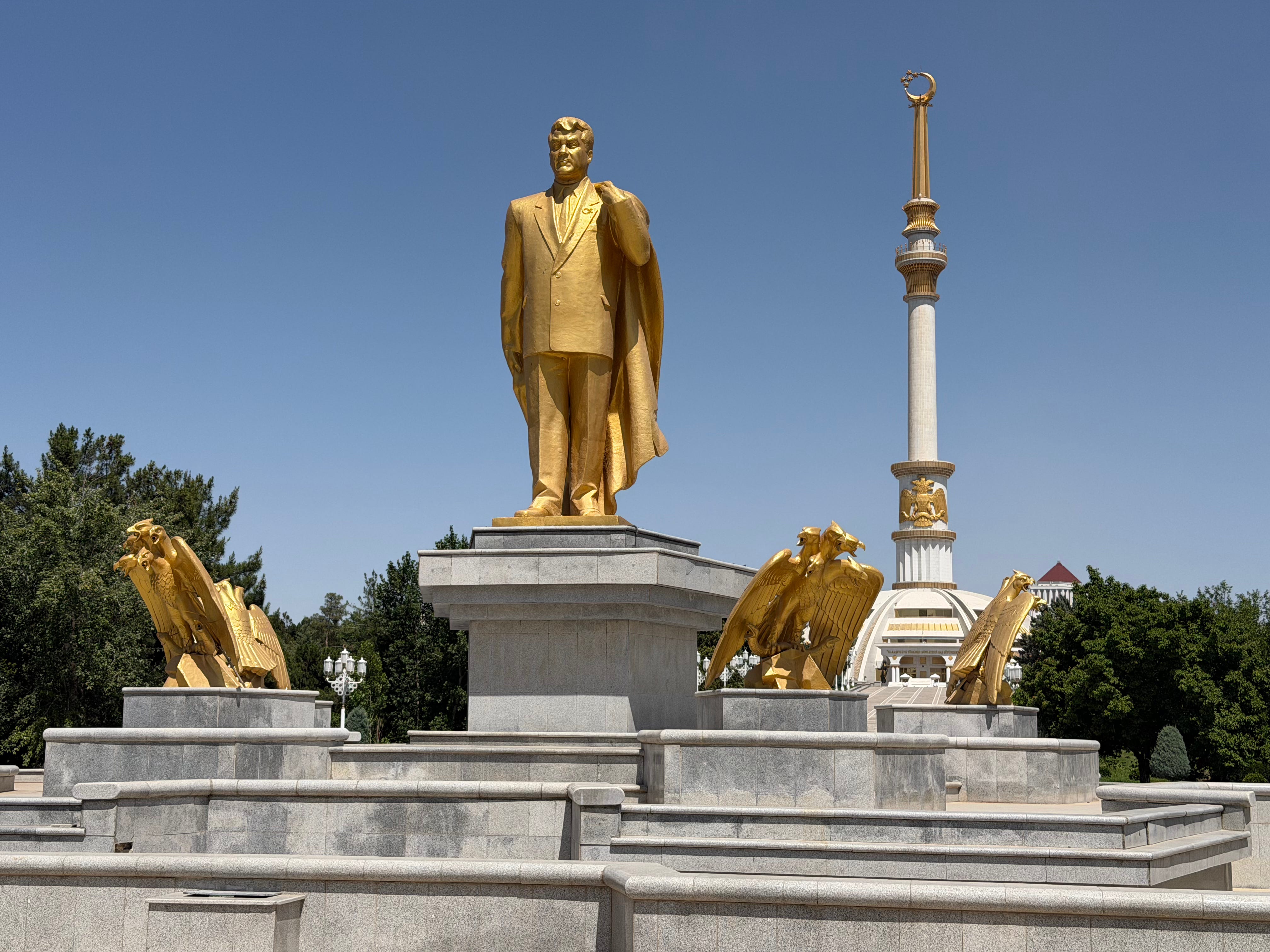
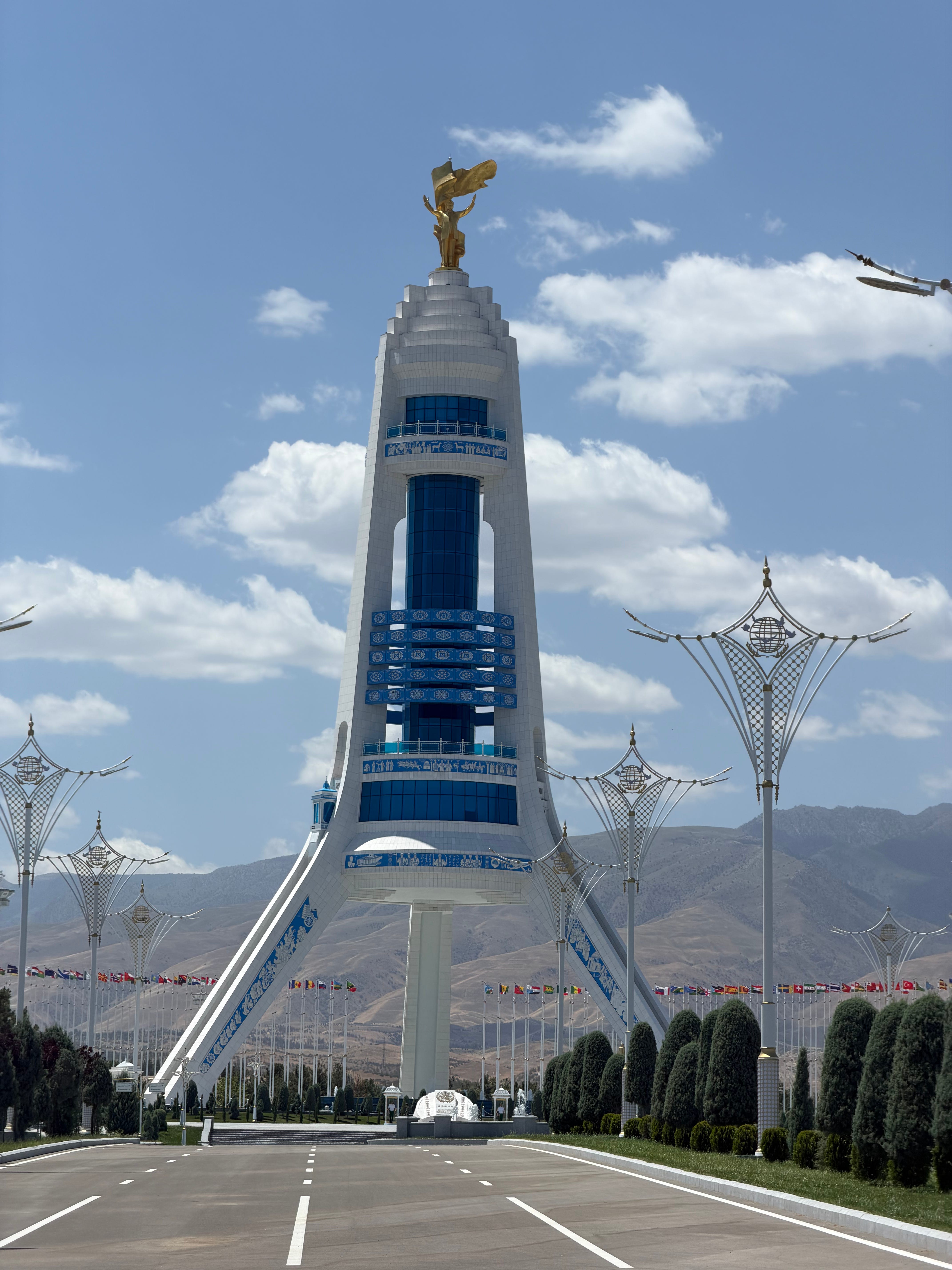
Just over the border, two technically (border controls to leave Uzbekistan are just as intense as arriving), is the equally young nation of Turkmenistan. By far the most populated city in the nation, Ashgabat, with a population of over 1 million, sits very near the Iranian border. Across the city, you may spot a few Timurid-style blue domes, but it’s the white marble structures that stand out the most amongst the surrounding desert landscape. The first president of Turkmenistan, Saparmurat Niyazov, would set his new nation on a very different path than that of Karimov’s Uzbekistan. To be clear, the Turkmen people can trace their history at least back to the 10th century. But the newly minted President Niyazov only wanted to look forward, and maybe a bit at the Soviet period. Ashgabat is home to the Independence Monument, a 118-meter-high white column that draws some design cues from traditional Turkmen tents, but its stark white marble construction invokes a totally different feel. Not to be outdone by the 185-meter-tall Monument of the Constitution, it does display some traditional Turkmen carpet designs, but again, the stark white marble and gold accents give it a wholly unique flavor. A line of ministry buildings in downtown carries a kind of object-like design accent. The Ministry of Education building is shaped like an open book, the Ministry of Foreign Affairs has a massive globe in its center (that actually functions as a conference room), and the Ministry of Finance has a large coin-shaped structure on top. To be clear, there are a few monuments that honor famous Turkmen of the past; a Godzilla-sized statue of poet Magtymguly Fragi was only just completed a few years ago, in addition to an accompanying park. But on the whole, the monuments and structures around Ashgabat give a very clear impression of the nation’s character.
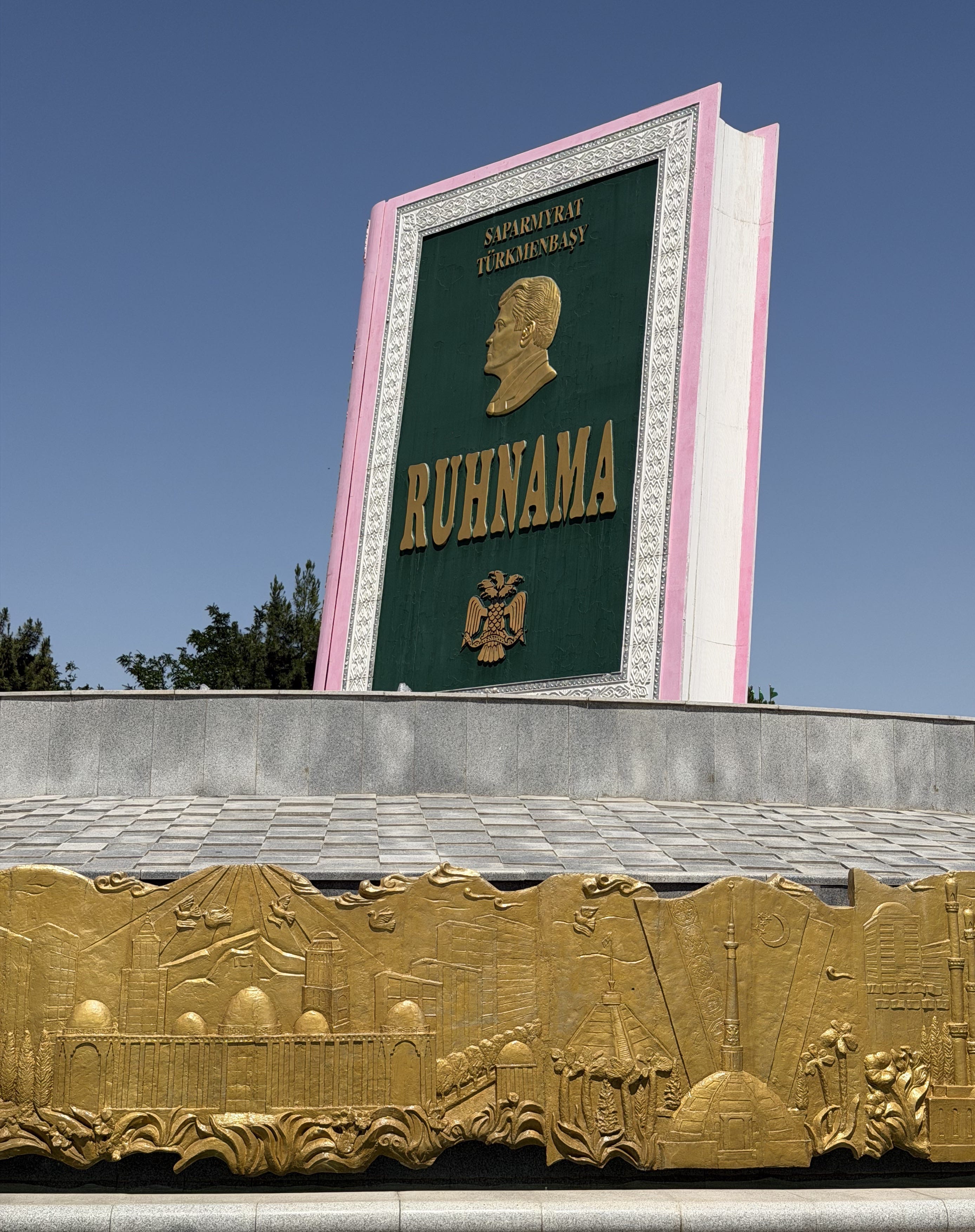
In the aftermath of their respective independence movements in the last days of the USSR, both Uzbekistan and Turkmenistan had to build national identities from scratch. Seeing that both nations’ borders had been drawn by Soviet authorities in the 1920s, that would prove to be a challenge. Both would embrace an authoritarian-style rule. And while both would also embrace a cult of personality-like civil culture, President Niyazov would take Turkmenistan close to a North Korean-style level of “reverence” with tests being administered on the Ruhnama to attain a driver’s license and January being renamed to “Turkmenbashy”. In fact, with the death of Karimov in 2016, any cult of personality-like behavior was dispensed with altogether. And both leaders would use monuments to build a new nation-state from the ashes. Karimov would use historical figures and stylized architecture to invoke a mythologized past to create a present and future. Niyazov would attempt to create a national identity with a very loose connection to the past, mainly rooted in what he promised his people for the future.
It seems both countries tried to answer the same uquestion of how do you build a national identity from scratch and came out with two opposite answers. Karimov reached back into a mythologised past, Niyazov invented a monumental future. An interesting read on a part of the world we don't see much written about, thank you for sharing, it was a refreshing read!
What comes through strongly here is how national identity formation after the Soviet collapse was not a search for history alone, but a decision about which direction in time a state chooses to anchor itself in.
Uzbekistan leans heavily on curated pre-Soviet continuity, turning historical figures and Silk Road memory into present-day legitimacy. Turkmenistan, by contrast, appears to construct identity more through projection and symbolism of a future-oriented state, with selective reference to tradition.
Seen together, they illustrate something broader about post-imperial states: identity is often less about recovering the past as it was, and more about choosing whether legitimacy flows from inherited memory or designed futurity.