
Castro's Gamble
Cuba's long war in Angola, and why it wasn't quite their "Vietnam"

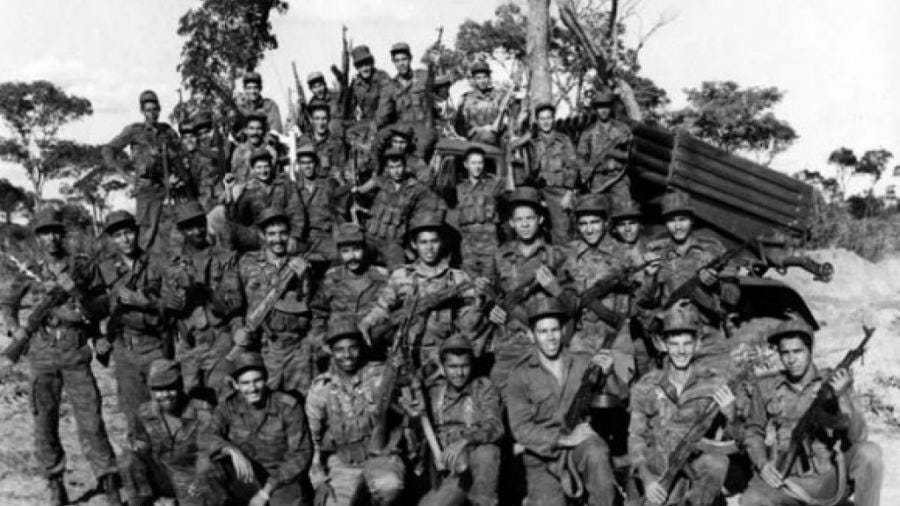
It’s generally agreed upon that the US involvement in Afghanistan is America’s longest war. But before that, it was US intervention in Vietnam that held the place of America’s longest war. Both of which lasted almost 20 years and would have lasting effects on the US psyche, socially and politically. Later, US involvement would become a euphemism for “quagmire”. Russia’s “Vietnam” would be its invasion and occupation of Afghanistan. Egypt’s “Vietnam” is considered its intervention in the North Yemen civil war. And beginning in 1975, just as America’s war was ending (although US forces had left in 1973), Castro’s Cuba would become entangled in the next Cold War hotspot: Angola. Tens of thousands of Cuban troops would be deployed, along with teachers, doctors, and tradesmen. And thousands would never return to their island home.
A military coup in Portugal in 1974, known as Operation Historic Turn and popularly as the Carnation Revolution, would set off a series of events that would engulf Angola in civil war and foreign intervention. But Castro and Cuba had had a relationship with the MPLA (Popular Movement for the Liberation of Angola) in Angola much earlier, starting in 1965. In that year, Che Guevara had set up shop in Congo next door, providing aid to local leftist guerrillas, and was also able to provide training to the newly-ish formed MPLA. In fact, there had even been earlier contact between Che and the MPLA in 1963 in Algiers. But at the time, Castro, and his brother Raúl, weren’t particularly interested in helping the MPLA. The Castro brothers had limited resources, and they felt, at the time, these resources could be better spent in Guinea-Bissau or Sierra Leone. But with the end of colonial rule in Angola, which was formally granted on November 11th, 1975, and hints that the apartheid regime of South Africa had its own designs in the region, helped convince the Castros that the MPLA needed aid, and fast.
Unlike the US in Vietnam, Cuba would not wait years to slowly escalate its involvement in Angola. From the outset, Cuba would send thousands of combat troops into the country, for both training purposes and combat operations. This massive buildup was known as Operation Carlota. By the end of 1976, there would be 35,000 Cuban troops in Angola. Most of these troops would be transported by ship, as the Cubans possessed only three large aircraft capable of making the journey nonstop. An odd twist to all this was that Castro did not attempt to consult with the USSR; he felt that they had become an unreliable ally in the aftermath of the Cuban Missile Crisis. In addition, the People’s Republic of China had already sent military instructors to help a group that was opposed to the MPLA, the FNLA. Any sense of “communist unity” was DOA, contrary to CIA reports at the time. The US and its allies would be somewhat slow to react, not thinking that Angola was a particularly important Cold War battlefield. South Africa, on the other hand, attempted to mirror Cuban movements with its own buildup. Another unique aspect of this intervention, which also helped to convince the Castro brothers to commit, was that Angola agreed to help pay for the materials used in the intervention with a mixture of local and foreign currency. Cuba’s rapid buildup was in direct response to South Africa’s assumed plans in Namibia and southern Angola. Castro hoped that this buildup would deter the apartheid government and quickly secure the MPLA’s survival.
This initial deployment would help funnel forces and technical advisors to the MPLA forces in the north of Angola. In that area, Cuban forces would be effective in pushing back local forces aligned with UNITA and the FNLA. This was, in turn, supported by “volunteers” from neighboring Zaire, French mercenaries, and a small contingent of South African troops. The settlement of Quifangondo was strategically important in that it was home to the largest water reservoir that supplied the capital, Luanda, just to the south. The Cubans were very aware that if this asset was lost to opposing forces, the capital could be squeezed and the MPLA pushed out. What would become known as the Battle of Quifangondo would be a resounding victory for the MPLA and Cuba and help ensure the further survival of Cuba’s ally. While this would be a setback for South Africa, UNITA, and the US, the war was just getting started. After this somewhat surprising victory, the Soviets would start to see the value of becoming involved and would attempt to synchronize their efforts with Castro. But like the US in Vietnam, there wasn’t a clear objective to be achieved that would have led Cuba to pull its forces from Angola. UNITA was a homegrown group that realistically would take tremendous resources to defeat. This would help inform another prong, Cuba’s strategy in Angola. Cuba would provide not just soldiers, but teachers and doctors. These elements would be in much need by the MPLA, as they had been ill-equipped for post-independence governance by the Portuguese authorities.
Other nations became more deeply involved in Angola, including the USSR and the US, and Cuba would find itself in a more support role. Later, as Soviet aid increased, the MPLA found itself dealing less with Cuba and more with the Soviets. The USSR was able to provide more money, more guns, and for a longer period of time. And as the US became more active in backing UNITA with money and advanced weapons, the MPLA saw the need for a superpower of their own as a patron. In addition, South Africa would begin deploying regular troops in an attempt to secure large swaths of southern Angola. After 10 years of fighting, both sides had made little progress. In 1987, the MPLA, Soviets, and their Cuban allies would begin preparing for a massive offensive in southern Angola. Initially, the SADF (South African Defense Force) would inflict massive casualties on the MPLA and Cuban forces. But as the SADF mounted its own offensive, it would be unable to break the MPLA’s defenses. The combined efforts of the USSR and Cuba would allow them, and the MPLA, to have total air supremacy. The SADF would struggle to deploy aircraft that could match the Soviet MiG-23. And the outcome of the battle would be inconclusive. But the battle would show the Afrikaner government that further fighting in Angola, against the MPLA, Cubans, and Soviets, was doomed to fail. What would come to be known as the Battle of Cuito Cuanavale would become the largest battle on the continent of Africa since World War II. The sheer scale of losses of men and material, on both sides, would push the participants to pursue the New York Accords later in 1988, help bring about a free Namibia, and push the Afrikaner regime to make adjustments to their domestic situation that would eventually bring an end to the apartheid government.
While the comparison between Cuba in Angola and the US in Vietnam is a bit thin, there is a thematic similarity at its core that is true. The label of “Cuba’s Vietnam” can fit in the process, but not in the outcome. Cuba made some early calls that would later be very beneficial to them in their aid to the MPLA. Getting large amounts of combat troops into the country, openly, in the very beginning, was key. In the end, over 4,000 Cuban troops died while serving in Angola from 1975 to 1991. And even after some initial friction with the USSR, which would frankly continue til the very end of the war, an attempt was made to work together. In addition, the Cuban decision not only to send soldiers but also teachers and doctors would have a longer-lasting effect on Angolan society. But was it worth it? Nelson Mandela might have summed it up best. Mandela credited Cuba’s role directly, noting that Cuito Cuanavale served as an inspiration to South Africans still fighting apartheid. In his words: ‘Cuito Cuanavale was the turning point for the liberation of our continent, and of my people, from the scourge of apartheid.”
https://cuba-solidarity.org.uk/news/article/3421/nelson-mandela-on-how-cuba-destroyed-the-myth-of-the-invincibility-of-the-white-oppressor
https://www.chathamhouse.org/2016/12/fidel-castros-greatest-legacy-africa-angola
https://www.opendemocracy.net/en/do-you-remember-cuba-dedication-to-angola/
https://omeka.uottawa.ca/recipro/exhibits/show/cuba-in-africa/case-study-angola-ii
I really enjoyed this, this wasn't an area I was well versed in so I appreciate your writing teaching me. Having read it, I think what saved Angola from becoming Cuba's Vietnam is that Cuba had a clear, limited goal, stop South Africa and keep the MPLA in power, and knew when it had won. Vietnam and Afghanistan had no such finish line, which is why they turned into quagmires. Cuba paid a high price, but for something it could actually point to I guess. Whether or not that price was worth the point, who knows! A really well-written piece as always though, thank you for teaching me something new!
Well Cuba technically won it was just a useless victory