
Nasser’s Graveyard
Egypt in Yemen

Lieutenant Colonel Gamal Abdul Nasser ascended to the Egyptian Presidency on June, 23rd 1956. He quickly became one of the most recognizable leaders not just in the Arab world, but the world writ large. A flawed man who brought hope and dignity to a people that had historically been dominated by foreign powers. But just ten years later, Nasser would find himself bogged down in a messy intervention that drained Egyptian military resources. The conflict would also see him square off against a fellow Arab state, the KSA. By the end of 1967, his project had failed, and he had lost 20,000 troops.
While Nasser began his road to sole power in Egypt in 1954, just two years later, in 1956, he would make a name for himself internationally. Over the course of the Suez Crisis, he would go nose to nose with the Israelis, the French, and the British, and came out ahead. This event would specifically make Nasser the de facto leader of the Arab world and the face of the “third world” struggle. At the same time, Nasser’s grand project of Pan-Arabism was just getting started, culminating in a political union with Syria in 1958, creating the United Arab Republic. But there would be opposition to Nasser’s revolutionary project. Western-backed monarchies and regimes that viewed Egyptian-centered supremacy with suspicion started to form a separate block. The Kingdom of Saudi Arabia (KSA) and Jordan formed the backbone of this anti-Nasserite group, and thus began the Arab Cold War. And soon enough, a new front in this cold war opened: Yemen.
On September 26, 1962, a military faction launched a coup in the capital city of North Yemen, Sanaa. Up until this time, North Yemen had been ruled by the Imamate, and at the time of the coup, Al-Badr was on the throne. While events were fluid on the ground during the coup, initial reports indicated that Al-Badr was killed in a bombing attack in the first hours. The group behind the coup, and subsequent attacks, was now known as the republicans. They would, in turn, appeal to Nasser for military and political aid against the remaining royalist forces. One of the early factors that would lead Nasser to make his fateful decision to send troops into Yemen was the initial reports that Al-Badr was, in fact, dead. It was under this guise that Nasser believed that only a limited number of troops would be needed, about 5,000. But only a few days later, word got out that Al-Badr had survived and was now in Saudi Arabia. His survival ensured that a royalist faction could take shape and engage the republican forces in combat. And thus would be born Nasser’s first great mistake. The next could be considered more of a geopolitical miscalculation, of sorts. Al-Badr had fled to KSA to seek refuge and possible support. But he was initially met with trepidation, and the Saudi monarchy maintained a rather lukewarm stance of support. But when it became clear that Egyptian troops were to be deployed, the kingdom decided to become more active in the conflict. This development signaled another level of escalation, to be matched by Nasser and the Egyptian army.
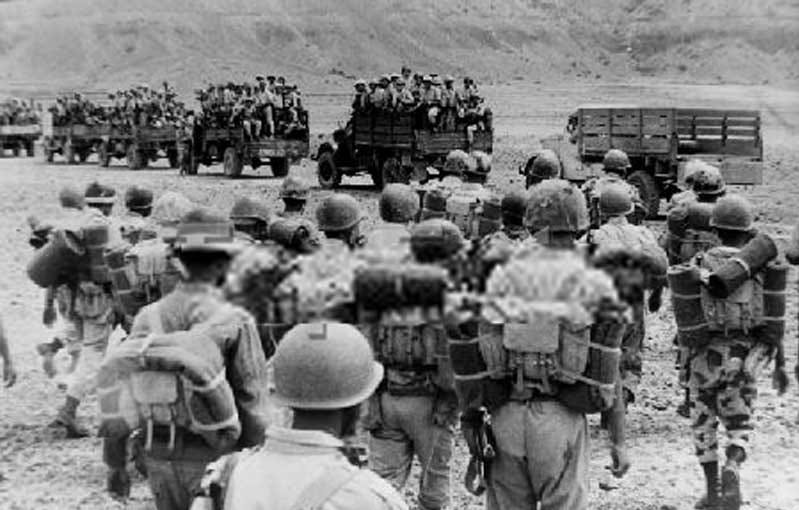
In the broadest terms, the Egyptian army’s experience in Yemen from 1962-1967 was one of counterinsurgency. This was not the kind of warfare that Nasser had built his army to fight. In addition to that, Egyptian intelligence on the ground, on a tactical and strategic level, was incredibly poor. The Chief of Egyptian military intelligence, at the time, once joked that the only thing that leadership knew about North Yemen was that it bordered Saudi Arabia. A specific issue early on was that the Egyptian army units deployed first had no maps of Yemen, and thus had to rely on locals, whose loyalty to the republican cause sometimes couldn’t be determined. It was hoped that the initial deployment of Egyptian troops would only last 3-4 months, culminating in what was referred to as Operation 9000 in October and November of 1962. The plan called for the Egyptian and republican forces to control all of North Yemen, with an emphasis on roads and other lines of communications connecting population centers. Also, the Saudi-Yemen border would need to be secured to discourage KSA support for royalist forces. But this plan was upended on October 10th, with a surprise royalist offensive that seized multiple towns in the eastern portion of the country and began looking for a way to advance on the capital, Sanaa. In a counter move, on October 22nd, Egyptian paratroops were dropped in the east of the country near Sirwah, in a bid to meet up with an armed column that was going to fight its way from the capital. But due to the aforementioned lack of maps, the paratroopers became lost and lost a third of their number to attacks from local tribesmen. The armed column didn’t fare much better, as royalist forces constantly ambushed it along the roads. It would be fighting like this, and other engagements throughout October and November of 1962, that showed Egyptian military leadership that a quick victory was out of reach. A serious strategic miscalculation had been made.
Next, the Egyptian military tried a “triangle strategy”: occupying the three cities of Sanaa, Hodeida, and Taiz, and having the republican forces handle the rest. This triangle also included the port of Mocha, where the Egyptian leadership massed forces and stockpiled supplies. The republican forces would be largely unsuccessful in their ability to hold territory outside the Egyptian triangle, thus making the “triangle strategy” a failure. In early 1963, royalist forces launched additional attacks that would culminate in the capital, Sanaa, being almost entirely encircled. In response, on February 16th, Egypt launched the first phase of the Ramadan offensive, with a second phase to start in March. This would prove to be a rare bright spot in the campaign, which yielded massive territorial gains. Planning for the offensive required Egyptian troop levels to reach 60,000. Another policy change came in January 1964, when the Egyptians decided that their forces were dispersed too widely and thus would now only be concentrated in “important” locations across the country. In mid-1964, Egyptian forces made concerted efforts to capture, or kill, the imam but to no avail. As 1965 dawned, Egypt’s troop numbers surged to 70,000 in country, and royalist forces began to crumble. Egypt had also begun to deploy and use limited amounts of chemical weapons, their first use since the end of World War II. The first reports arrived in June 1963 and were considered experimental. Mustard and chlorine gas became more commonly used later in the war and accounted for maybe 1,500 casualties. A dual track would also be pursued, one of diplomacy and one of even further escalation. Nasser began putting out diplomatic feelers to see whether a political agreement could be reached between the two factions. Egyptian military command considered a gradual invasion of KSA as a way to cut off the critical aid the royalists were receiving from the Saudis.
In late 1962, Nasser attempted to export his pan-Arabism to the Yemeni people. He also hoped to further entrench his position as the foremost Arab leader of the foremost Arab nation. He was even willing to risk open war with a fellow Arab nation to achieve this. And maybe even push the British out of Aden, if there was some time. But there wouldn’t be any. The Jeddah Agreement was reached in 1965, with Egyptian troops to be withdrawn over the course of 1966. But the agreement soon broke down, with Egypt attempting to keep its forces in Yemen even longer, reintroducing the “triangle strategy” from 1962. In addition, the Egyptians would place more importance on training republican forces, and having them do more of the fighting. Maybe a “Yemenization” of the war, if you will. But history had other plans; on June 5th, 1967, the Israeli air force would launch the beginning of what became a catastrophic defeat for the Egyptian army. But the origins of the defeat were written in the Yemeni mountains in 1962. 70,000 of Nasser’s best troops were tied down in the Yemeni quagmire. And it was the Six-Day War with Israel that finally, in the worst way possible, helped start the process of bringing the troops home. Egypt’s intervention in the North Yemeni Civil War has been called “Egypt’s Vietnam”. But upon a closer examination of the timeline, it might be more apt to call the US intervention in Vietnam “America’s Yemen”.
https://wyomingalmanac.com/?p=968
Yahel, I. (2026). “Nasir’s Vietnam”: analysing Egyptian intelligence literature on the Yemen intervention. British Journal of Middle Eastern Studies, 53(1), 171–188. https://doi.org/10.1080/13530194.2024.2443924
Bregman, A. (Ed.). (2008). Warfare in the Middle East since 1945 (1st ed.). Routledge. https://doi.org/10.4324/9781315234304
The Arab Cold War between Nasser's Egypt and the revolutionary nationalist states and the Saudi led royalist states is one of the most important geopolitical conflicts in history that nobody knows. Salafism probably remains a minor global force without the Saudis promoting it as a legitimizing counter-ideology to pan-Arabism, as the monarchies were constantly under threat of coups by nationalist officers.
Really expertly written this. Covers much of the conflict in not so many words, great to read!