
PMC 2.0
Part 1: The South African Model

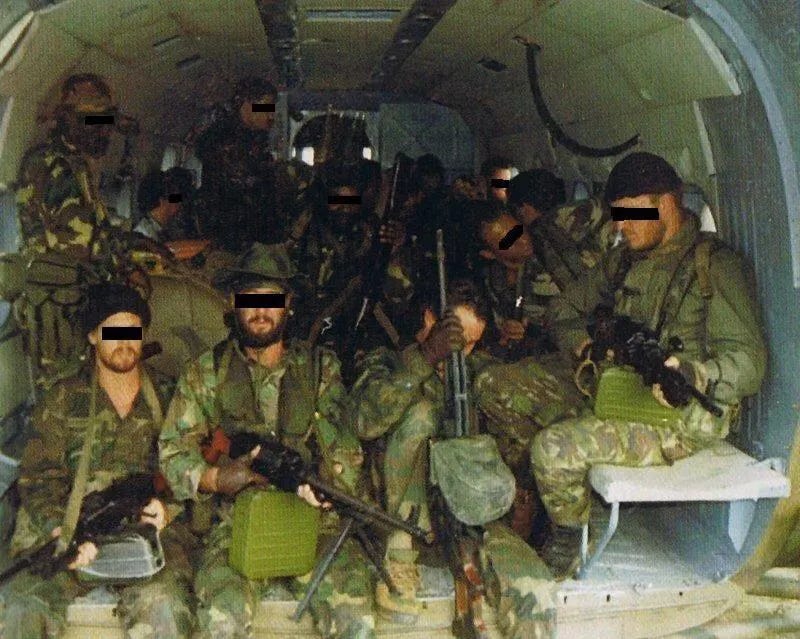
The inciting incident of the Rwandan genocide was the assassination of Juvenal Habyarimana and Cyprien Ntaryamira on April 6th, 1994. Within 24 hours, mass killings of ethnic Tutsis and moderate Hutus would begin. The world would watch idly as a postcolonial state would come to a reckoning with its colonial past, in the most monstrous way possible. But what is not so well known is that a South African-based PMC (private military company) offered to deploy 1,500 troops to help stop the killing in 1994, asking “only” $150,000,000 for the job. Both the US and the UN, at that time led by Kofi Annan, were opposed to such an arrangement, and the deal was scuttled. 800,000 people were killed over the course of a few months. Was the right decision made? Hard to say. But the PMC has seen a new lease on life in the post-Cold War security environment. They have been able to adapt and change as the security environment itself has also shifted.
In the immediate aftermath of the dissolution of the USSR in December 1991, the End of History was heralded across the world. But in many regions, this was merely rhetoric. Civil wars and regional nation-state conflicts would rack Sub-Saharan Africa, the Balkans would become a killing field, and Western and Central Asia would see significant clashes. But it would be the end of the Apartheid government in South Africa in 1994 that would have a unique effect on the post-Cold War security situation. The Afrikaner regime in South Africa was mainly known for its oppressive and racist apartheid-style government. What was less known was the incredibly high levels of militarization within the South African state. This was buttressed by a highly developed defense industrial base (DIB) capable of developing and producing arms with little outside help. But once de Klerk handed over power to Mandela and the ANC in 1994, the bottom fell out of this robust military machine. Thousands of highly trained soldiers were out of work, and millions of arms were no longer needed. In addition, many thousands in the post-Soviet space, especially in Eastern Europe, would find themselves in a similar situation. It would not be long before they found a new purpose, and price, in this new world.
This is how the “South African” model was formed. This model would be close to what is traditionally thought of as “classical” mercenaries, soldiers hired to fight on behalf of their client. Additionally, natural resources would sometimes be used as payment, or control of a natural resource would be given as payment. Combined with other freshly unemployed soldiers from the former USSR, private armies were starting to form on the southern end of the African continent. Thus, Executive Outcomes (EO) was born. This would not be the first PMC formed, but it would be the first to be thrust onto the international stage. EO would sign its first major contract with the Angolan government at the outset of the Angolan Civil War in 1992. The main point of this contract was to train Angolan forces to fight UNITA, as a prior peace agreement had been shattered by a disputed election. Later, EO forces would be directly involved in combat operations and would help bring UNITA to the negotiating table. But it wouldn’t be long until the UN and the US would force the Angolan government to end its contract with EO. Once EO was forced to leave, the security situation deteriorated, and fighting resumed. After this, in March 1995, EO would sign another major contract with the government of Sierra Leone; it would be this contract that would become EO’s legacy. In fact, the government of Sierra Leone would end up partly compensating EO with rough diamonds. Again, EO forces would find themselves directly involved in combat operations that halted the RUF offensive. And again, the UN and the US would force Sierra Leone to end its contract with EO and have them leave the country. Thus, a breakdown in the security situation would follow. This would be capped off in 1998, with the dissolution of Executive Outcomes. But the floodgates were now open as the world had seen the potential, both negative and positive, of what PMCs could bring to the post-Cold War era disorder.
As Executive Outcomes ceased to exist, other PMCs were starting to come online, and even EO itself wouldn’t totally disappear. A British PMC, Sandline International, would find success in Africa as well, not long after its South African counterpart. EO showed the world that in a post-Cold War era, no longer bound by the past security establishment, security could be found, but for a price. But for better or worse, this “soldiers-for-hire” solution was seen as unsavory at best, to say the least. The countries that turned to EO, and later would turn to similar groups, were nations that had been on the fringes of the bipolar world order. And when that order crumbled, those nations found themselves in a tough situation. It was clear that the US was not a fan of a private army “stabilizing” part of sub-Saharan Africa. Overall, with a US “victory” in the Cold War, and the chaos that would consume the former third world, it would be very fitting that a “private sector” solution would be found to this problem. But soon enough, nation-states would see the benefits of this new private sector option of “stability”.
https://www.gisreportsonline.com/r/private-military-companies/
https://www.consilium.europa.eu/media/66700/private-military-companies-final-31-august.pdf
I find it interesting that the “classic” PMC model was so short lived. Then you had the GWOT model of PMC where the PMC was tightly state associated (Wagner, Blackwater) and mostly served as a way to obfuscate state costs and casualties of long running wars
And now we’re getting a third model, where mercenaries are more common than ever but they’re being hired on an independent contractor basis, rather than big multinational companies. Russia recruiting manpower from around the world, Ukraine experienced volunteers then being paid by cartels or Sudanese factions for their drone skills