
PMC 3.0
The Blackwater Model

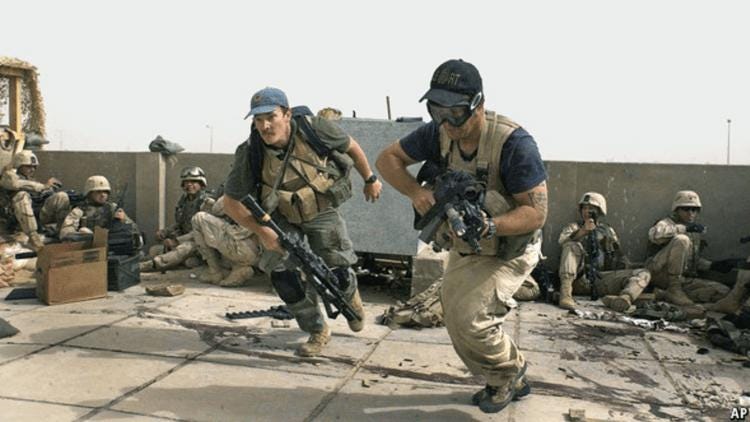
With the terrorist attacks of 9/11, the US would be shaken from its roaring 90s hangover to see a world that was still coming out of the chaos of the post-Cold War order. Very soon, the US would launch a modern-day punitive expedition to Afghanistan to chase down Osama bin Laden and his Al-Qaeda compatriots. And not long after, the US would invade Iraq in a bungled attempt to keep Saddam from attaining nonexistent WMDs. America would now find itself in a two-front war in the Middle East, historically an unenviable position. This would strain a US military that had been massively drawn down by post-Cold War defense spending cuts and a hubristic attitude that a “light footprint” in both theaters was sustainable. It would be these twin issues that would push the US government to seek help from the private sector. The US had experience working with PMCs in the past, of course, in a limited way, during its 1991 Gulf War; security contractors were used in logistical roles in Saudi Arabia and for security on oil platforms. But with the US military being deployed to two separate nations, the US government would be forced to embrace PMCs like never before. This would lead to the rise of the next “great” name in modern PMC history, Blackwater.
Blackwater would mark a “second wave” of expansion in the PMC industry. But it would differ from the preceding wave in its model and appearance. Whereas EO and the South African model generally would be marked by a more traditional mercenary image, Blackwater would come to symbolize a more entrepreneurial style and image. Overall, the word mercenary would be changed to PMC and the jungle camo print would be traded in for a three-piece suit. Blackwater was founded by Erik Prince and Al Clark in 1997 and started as a training center for security officers in the US government. But their first major contract would be to deploy protection and security of US installations in Afghanistan. They would later be brought in, within months of their invasion, to the US occupation of Iraq to provide security for CPA (Coalition Provisional Authority) head Paul Bremer. But Blackwater wasn’t the only game in town, but was by far the most well-known. Triple Canopy and DynCorp International would compete for the very same contracts. Both of these companies provided security services, while Triple Canopy would specialize in physical security, like Blackwater. DynCorp was a much larger and older company that started in aviation. All three companies would come to symbolize the post-9/11 US security conundrum that was faced by the two fronts in the Middle East. Then, on September 16, 2007, the Nisour massacre would change Blackwater and the US private security industry forever. That day, a Blackwater Tactical Support Team (TST), responding to an attack on a meeting of US and Iraqi officials, would launch a bungled attempt to secure an evacuation route that would lead to the killing of 17 Iraqi civilians. 40 more would be wounded. And with Blackwater personnel being the perpetrators of said shooting, by the end of 2007, the company would pursue a rebrand and slowly move away from physical security contracts. This, combined with increased oversight from Washington, would lead to a slow push to award fewer private security contracts and to move those that already had been out of public view.
In addition to all of this, European countries that had deployed troops to Afghanistan and Iraq would also slowly look towards their own domestic PMCs to assist with logistical and security needs. This, in effect, would be another lingering piece of the post-Cold War security architecture, specifically in Europe. In the aftermath of the Cold War, European defense budgets had been in free fall, even more than those of the US. And now that various European nations had deployed troops abroad, the European economy would need private-sector help. Specifically, UK firms would have much to gain. ArmorGroup would be enlisted to provide security services in Afghanistan, Atermis Contractors would help in Iraq, among others. Several French firms would also be present: Anticip, DCI, and GEOS.
With the twin US invasions of Afghanistan and Iraq, a second wave of PMC growth would come to be. The US government couldn’t be seen working with, let alone paying, the same kind of companies they had just recently disparaged. But the fact remained, the US needed additional bodies to help with its newly minted War on Terror. This “rebrand” would have a dual purpose: newly created PMCs would have a new PR image, and Western governments could do business with much less public outcry. But this was merely marketing; the core concept of EO and Blackwater was the same. In fact, this rebrand strategy would be embraced by Blackwater itself, which would go through various changes of its name and logo. But one interesting change was the nation-states’ use of a domestically based PMC to help carry out foreign policy objectives. Other nations would take note of this relationship, make their own changes, and help kickstart a third wave of PMC expansion. The age of the corporate mercenary was ending. The age of the state mercenary was about to begin.
https://www.gisreportsonline.com/r/private-military-companies/
https://www.consilium.europa.eu/media/66700/private-military-companies-final-31-august.pdf