
Relationship Status: It’s Complicated
Moscow and Tel Aviv’s delicate dance in the Middle East

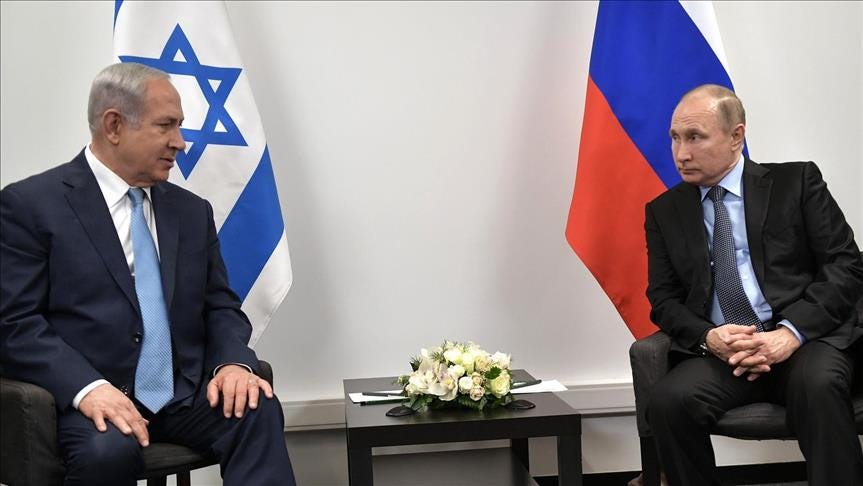
This past April, a diplomatic row started between Israel and Ukraine. Ukraine accused Russia of selling stolen grain that was being sent to the Israeli port of Haifa. The Ukrainian government alleges that the grain in question had been farmed in territory occupied since the Russian invasion of February 2022, and that the Israeli government knew of its origin. This was not the first time that a Russian-flagged cargo ship had brought stolen foodstuffs to Israel. And why would a “strategic” ally of Iran be attempting to supply their mortal enemy with food? It’s the latest episode in one of the most complicated relationships in international relations: Russia-Israel.
From the outset, Russia and Israel have been strange bedfellows. Stalin’s USSR was among the first countries to recognize Israel after its creation. At the same time, antisemitism within the USSR was rampant. Some have speculated that Stalin’s acceptance of an Israeli state was done in hopes that it could counterbalance British interests in the Middle East. Later, Khrushchev would throw the USSR’s military muscle behind Israel’s Arab nationalist neighbors and would later sever relations with Israel in the aftermath of the 1967 Six-Day War. At the same time, the Russian Orthodox Church would maintain its representation in Jerusalem. And this would be the state of Russia-Israeli relations until the very end of the Cold War. At the tail end of the Gorbachev era, relations between the two would be reestablished. Russian President Boris Yeltsin would also make a concerted effort to improve relations with Israel in the mid-90s. But the true breakthrough would start with Putin’s rise to power in 1999. Israeli Prime Minister Ariel Sharon and President Putin would see themselves in a joint struggle against radical Islam. Also, around the same time, Israel would see a massive number of Russian Jews emigrate to Israel. This would create a social link between the two nations that would have dramatic effects on their relationship. In addition, on the Russian side, Israel was seen as a new source of advanced weapon technology that could be used to augment existing Russian weapons systems. Israel would also withhold criticism of Russia’s war in Chechnya, Georgia, and the initial Russian invasion of 2014. But beginning with the Arab Spring, relations would take all kinds of different turns.
Both Russia and Israel would strike similar tones with the outset of the Arab Spring in 2010-2011, one of maintaining the status quo. Both preferred the devil they knew to the one they didn’t. A place where this became most clear was in Assad’s Syria. Syria had, at that time, hosted the last Russian military base outside the former USSR. And while Israel was not exactly friendly with Assad, peace had been kept along the Golan Heights since the end of the 1973 October War. Of course, Russia would be the one to act most publicly in its support for Assad, announcing a major military intervention in 2015. But this would immediately create a complicated situation for Israel. Russia was not working just with the Assad regime, but also with the Iranian Quds Force and Hezbollah’s elite Radwan Force. There were hopes on the Israeli side that Russia would act to restrain Iranian ambitions in Syria. Russia made little to no effort to impede Israeli airstrikes against Iranian and Hezbollah targets in Syria over the course of the Syrian Civil War. In fact, there has been much coordination between the two states. Israel has also hoped that Russia can deter Turkish aggression and intervention in Syria, which it sees as a regional rival, at times. But it would be 2022 that would see another real test of this supremely complicated relationship.
February 2022 would see a massive Russian invasion of Ukraine. No longer would Russia rely on grey-zone warfare and proxies. Western governments, especially the US and Europe, would line up to condemn and sanction Putin’s Russia. But one very key Western ally would remain totally silent: Israel. Israel would object to any military aid being sent to Ukraine. Even a request, directly coming from the US, regarding the transfer of a Patriot missile battery was rejected. At this time, Netanyahu still needed Russia in Syria and thus saw no need to antagonize Putin. But with Russia’s increased reliance on Iranian Shahed drones, a deepening of the Russian-Iranian relationship would commence. But both Russia and Israel would hope to keep their relationship compartmentalized, and thus still saw each other as useful in the Middle East theater. But this, too, would be soon thrown into chaos.
With the Hamas attacks of October 7th, 2023, Israel soon began a war to remake the entire Middle East. Russia would start from a position hoping that “both sides” would show restraint. Israel would launch an increasing number of airstrikes against IRGC targets in Syria starting in late 2023. This would culminate in the April 1, 2024, Israel strike that would target General Mohammad Reza Zahedi, a senior commander in the Quds Force. This would trigger the first series of missile exchanges between Israel and Iran. Russia, Iran’s partner in Syria, would push a cautious line of “restraint”. But Russia’s calculus would change in December 2024, with the fall of Assad. This could end a clear point of coordination between Russia and Israel. Hence, the Israeli ground incursion into southern Syria. Iran would now become the clear pressure point between the two. With Israel commencing its 12-day air war against Iran, the Russian-supplied air defenses would prove essentially useless. There has been some speculation that Russian intelligence had passed sensitive technical information about the S-300 systems that they had supplied to Iran to the Israeli military. In addition, Russia has generally withheld its most advanced weapons systems from Iran.
With the beginning of Operation Epic Fury and Roaring Lion on February 27th, the separate codenames for general US and Israeli strikes against Iran, a new dimension to the Russia-Israel relationship would come to light. This time, both the US and Israel would be striking targets inside Iran. With the US and Russia already in a less-than-friendly situation, it comes as no real surprise that Russia was likely providing Iran with targeting information regarding US installations in the Gulf. But what has been absent from these reports is whether Russia is providing any sort of support for similar Israeli targets. This, in and of itself, shows that Russia is still trying to compartmentalize its relations in the Middle East.
Russia and Israel have been able to maintain, and develop, one of the most complex relationships in international relations today. There haven’t been any signs of major ruptures, even with multiple, direct confrontations between Israel and Iran. Israel sees a need for Russian influence in the Middle East. Even with the USA as the major ally, Jerusalem will always see a reason to hedge against a potential US disengagement from the Middle East. Russia, on the other side, will continue to keep Iran at arm’s length, for fear of alienating the Israelis. One could also imagine a line of thinking among Russian ultra-nationalists that it’s better to balance out its Middle Eastern relations between an avowed Islamic revolutionary government and a Jewish-based state than fully align itself with either. And perhaps most consequentially, Israel’s relationship with Russia may be the single most under-appreciated factor limiting Moscow’s support for Tehran, a quiet but powerful constraint that neither side will publicly acknowledge.
https://www.iss.europa.eu/sites/default/files/EUISSFiles/CP_146.pdf
https://mepc.org/commentaries/russia-israel-a-complicated-friendship/
https://www.jstor.org/stable/resrep21000.8?seq=1
This isn't confirmed but it's widely believed in Georgia that Israel purposely disabled drones that it sold to Georgia during the 2008 war as part of a deal with Russia
Whats not to understand, about israel/room full of jews,
is an american “ally”. Allied with your enemy.
Putin KNOWS THAT.
He’s not a trump or biden placement moron.
He’s not the kind of dummy who has to bloviate the obvious out loud.