
The Vela Incident
The (maybe) nuclear test that nobody will admit to

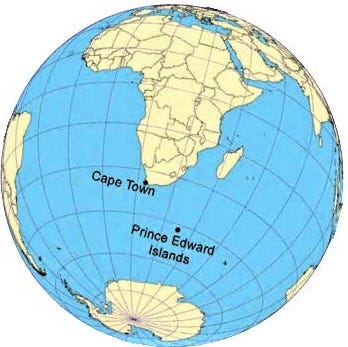
On September 22, 1979, a somewhat outdated Vela satellite detected a double flash near the Prince Edward Islands in the Indian Ocean. The Vela series of satellites was specifically designed to detect nuclear explosions and tests. While the satellite had various instruments to detect atmospheric radiation, none was detected. But with a “double flash”, with the second flash being longer than the first, it was a clear indicator of a nuclear explosion. Alarm bells went off in Washington. Who would have done this? Was it an attempt by the USSR to conduct a “secret” nuclear test? Was it an atmospheric anomaly? Maybe a meteorite? But the truth was most likely more terrestrial, and maybe even closer to the explosion site than initially thought. And thus might have just revealed one of the most covert, understudied, and consequential geopolitical relationships of the modern era.
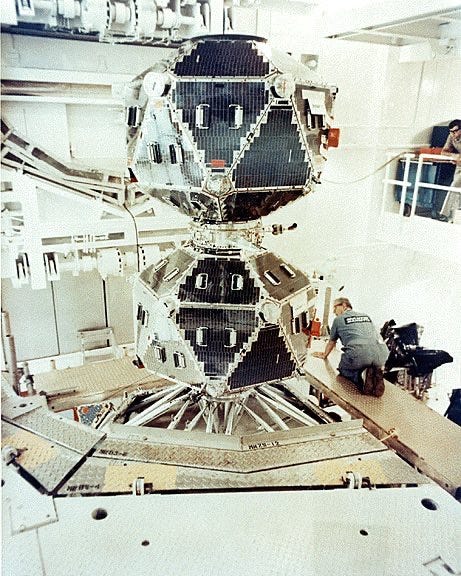
Most documents on the immediate White House reaction remain classified, but in recent years related documents have come to light. As mentioned, the Vela satellites were designed to detect nuclear detonations, with an eye towards Soviet compliance with the Partial Test Ban Treaty of 1963. And that’s what Vela OPS 6911 seemed to detect on the 22nd of September. There were anomalies detected, with the double flash, that were not in line with what was expected from a textbook nuclear explosion. In addition, questions were raised about the reliability of some of the satellites’ onboard instruments, as the Vela series was two years over its designed operational timeline. Only a few days after the anomaly was detected, the White House called upon three senior scientists to do an initial review of the data. Former Director of the Los Alamos National Laboratory Harold M. Agnew, H-bomb co-designer and IBM Watson Laboratory researcher Richard L. Garwin, and the FCC’s Chief Scientist Stephen Lukasik were called upon. But there was a clue to the White House’s initial thoughts about the incident; one only had to look at the résumés of those asked to review. And the conclusion of this initial panel, only recently revealed, was quite clear: “2 to 1 in favor” of a nuclear explosion.
But if it was a nuclear detonation, who pushed the button? It was unlikely to be the Soviets, who had been holding to the 1963 treaty obligations. China was a possibility, but they would not need to test in the Indian Ocean; in fact, just the next year in 1980, the Chinese would conduct the last known official atmospheric test on record. But just to the north of the supposed blast site was the apartheid nation of South Africa. At this time, South Africa had a small and fledgling nuclear program, but it was kept secret and mainly underground. The US and European companies had provided expertise on nuclear reactor construction as early as 1965. South Africa also possessed its own domestic sources of uranium that it could mine, and later refine into weapons-grade material. But US intelligence assessments at the time of the Vela incident doubted that the Afrikaner government was in possession of enough material to build a bomb, let alone one to test. But there was another country, known to have defense links with South Africa, that had its own small nuclear arsenal that was likely to test one of its weapons in secret: Israel.
Israel’s path to nuclear power status is beyond the scope of this piece, but for the sake of clarity, I will cover the highlights. The first Prime Minister of Israel, David Ben-Gurion, was clear from the beginning that the state of Israel needed nuclear weapons. Israel was the second nation to sign up for the US’s Atoms for Peace initiative in 1955; this agreement would allow the US and private companies to share peaceful nuclear technology with Israel. A few years later, in 1957, the French would provide a nuclear reactor to Israel. This would form the basis of the Dimona nuclear facility where Israeli nuclear arms were eventually born. It is believed that Israel had its first operational nuclear weapon just before the Six-Day War of 1967, in December 1966. Israel would also adopt a policy of “strategic ambiguity” when it came to its possession of nuclear weapons. But it would engage in exchanges, and in 1975 the two nations would sign a secret defense agreement centered on the exchange of nuclear technology. South Africa provided the Israeli facility at Dimona with significant quantities of yellowcake uranium. Israeli scientists would go to South Africa to provide technical expertise on enrichment and bomb design. And thus, the most popular theory behind the Vela incident was born. Likely, an Israeli nuclear device was tested with logistical help from apartheid South Africa.
But it wouldn’t be long until the Carter administration would realize that there would be a political cost to accusing Israel of an illegal nuclear test. A second, more official panel would be convened to help illuminate the situation. This panel would be known as the Ruina Panel. Essentially, they concluded that the double flash was most likely caused by an atmospheric anomaly, possibly even a small meteorite. But with retrospective analysis, there may have been some political pressure on the panel to come to a scientific reason for the Vela anomaly, as opposed to a political one. The embarrassment of a US ally, Israel, conducting an illegal nuclear test, in partnership with a nation the US had gone to bat for more than once, South Africa, would have been a diplomatic nightmare. To be clear, there is little to no direct evidence regarding any pressure on the Ruina Panel from any senior White House officials, like Carter, Brzezinski, or others.
To this day, there has been no official explanation for the Vela incident. And many of the documents regarding its discussion and analysis are still classified at the highest level. Even the most commonly accepted theory, a joint Israeli-South African nuclear test, lacks real physical evidence. And there has only been second-hand sourcing from the Israeli side, via Seymour Hersh, and nothing from the South African side. Additionally, South Africa would disassemble its entire nuclear arsenal over the course of 1989, thus renouncing its nuclear power status, along with any possible evidence of its involvement with the Vela incident. This situation would go down as one of the first major breaches of the non-proliferation regime that the US, and at that time, the USSR was attempting to install across the world. There is a very clear line, if one chooses to believe that the Vela incident was a nuclear detonation, from Israel’s ruthless pursuit of nuclear arms to the Afrikaner regime’s acquisition. A similar line would later be seen from Pakistan, through AQ Khan, to North Korea. In the end, the world may never really know what happened near Prince Edward Island on September 22, 1979, but the silence itself speaks volumes about the future of the non-proliferation regime.
https://www.wilsoncenter.org/blog-post/revisiting-1979-vela-mystery-report-critical-oral-history-conference
https://www.politico.com/magazine/story/2016/12/1979-vela-incident-nuclear-test-israel-south-africa-214507/
Fascinating - I was completely unaware of this event let alone joined the dots. One of those instances where the silence can almost be seen as evidence given there is a lack thereof. Really informative piece, as always!
A great article about something I never knew about. I must say having a map greatly enhanced my visual on the article. Keep up the great work.