
Turkey’s Most Powerful Weapon
An 88-year-old document that constrains great powers

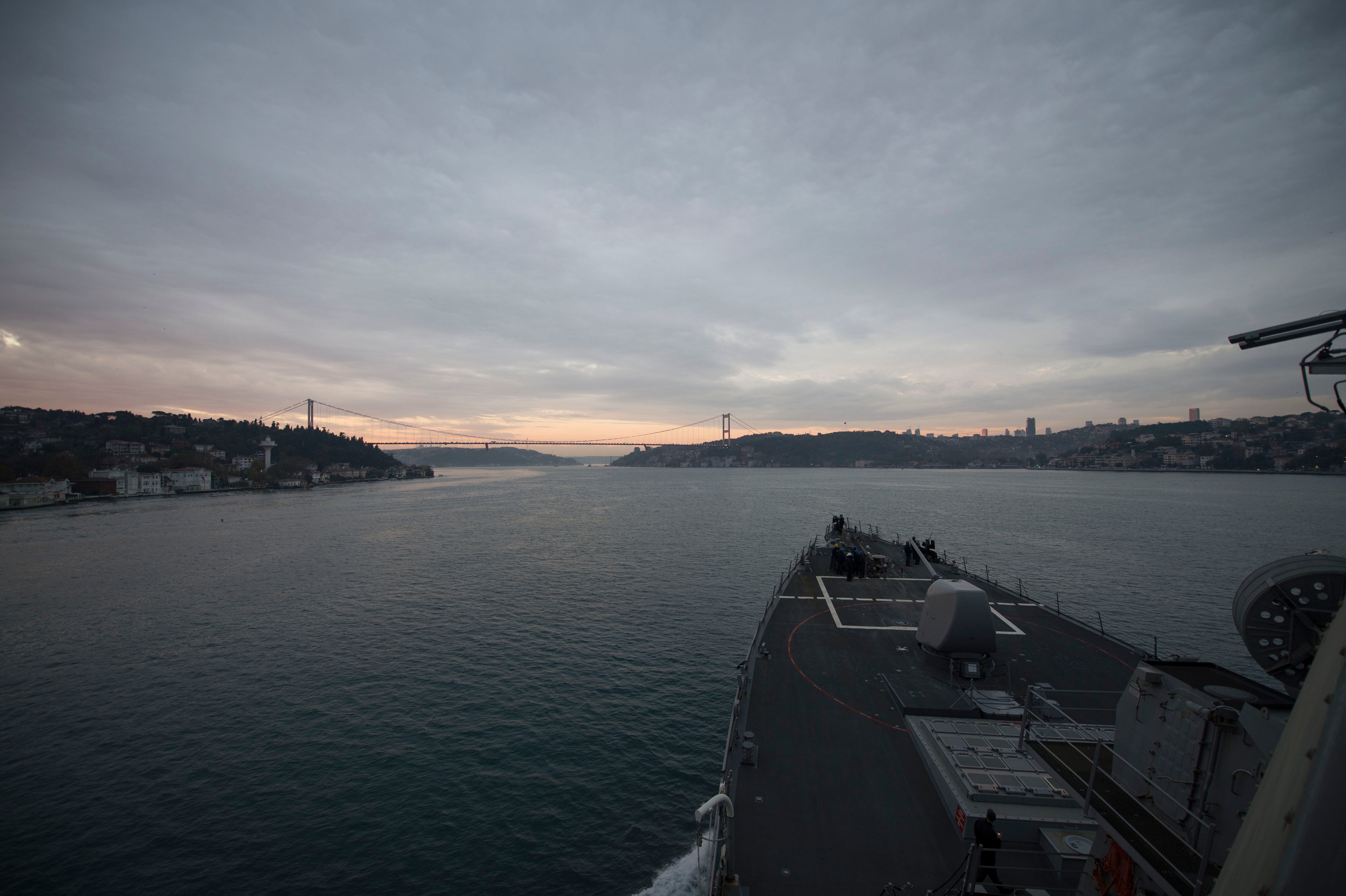
On February 24, 2022, the Russian Federation would launch a full-scale invasion of Ukraine proper. The once sleepy Russian Black Sea Fleet would be sent into action. 96 hours later, on February 28, Turkish President Recep Tayyip Erdoğan would invoke a little-known 1936 document that would come to bear on the Russian war machine. Formally known as the Montreux Convention Regarding the Regime of the Straits, or simply the Montreux Convention, it was signed by the original signatories on July 20th, 1936, and put into effect on November 8th that same year. The image was striking: a 21st-century conflict launched by a nation whose government wasn’t in power as an original signatory, and against a nation that didn’t technically exist at the time of signing.
The “Turkish Straits” technically consist of three different bodies of water. The northernmost of which is the Bosporus Strait, which runs through the heart of Istanbul (formerly known as Constantinople). Its narrowest point is only 700 meters, which is less than half a mile. Just a bit further south is the Sea of Marmara, which is surrounded on all sides by Turkish territory. The last piece is the Dardanelles Straits. These three bodies of water are the only way for ships to transit from the Black Sea to the Mediterranean and the oceans beyond. Over 84,000 vessels have passed through the Turkish Straits over the course of 2025. In addition, this makes the straits extremely important to any state that shares a littoral border with the Black Sea.
The Montreux Convention was the culmination of a series of agreements that started in the 1841 London Straits Convention, when the straits were under the control of the Ottoman Empire. The next major agreement would be the 1923 Treaty of Lausanne. This agreement mostly dealt with unsolved issues left over from World War I, but also addressed issues regarding the Turkish Straits. But with the rise of fascist Italy and its expansionist aims across the Mediterranean, a new agreement was needed. This would lead directly to the creation of the Montreux Convention of 1936. And this new agreement would lay down very clear specifics regarding the transit of warships through the straits. Black Sea bordering states would need to inform the Turkish government eight days before passage, and non-Black Sea states are required to notify 15 days prior. One of the most interesting pieces is that which deals with aircraft carriers, or lack thereof. Aircraft carriers are not mentioned explicitly in the text, but all current aircraft carriers are over the 15,000-tonne limit of warships passing through the strait. Only Black Sea states are allowed to pass that limit, which means the USSR, now the Russian Federation, can technically pass through. In fact, the Soviets specially designed their Kiev and Kuznetsov classes as “aircraft-carrying cruisers” to bypass any limits. At the time of this writing, the Turkish government has invoked the wartime provisions of the Montreux Convention under Article 19, preventing Russia from transiting warships through the straits. But this wouldn’t be the first time Russia would push the limits of the convention.
Over the course of World War II, the Turkish government would close the straits, mainly to discourage the Axis powers from its usage. But this would also extend to the USSR, which wasn’t allowed to transit warships through the straits either. In 1946, the USSR would lodge a formal diplomatic complaint with the Turkish government regarding this issue. The claim went that the Soviets believed that the Turkish government no longer truly represented the security interests of the Black Sea nations. Furthermore, Stalin specifically wanted to push Turkey to accept partial Soviet control of the straits in a kind of joint governance of the vital checkpoint. But with US diplomatic support, the claim was dismissed by the Turks. In response, the Soviets would increase their naval presence in the Black Sea, in addition to new troop deployments to the Balkans. It would be these moves that would lead the US to send a naval task force to Turkey and push the Turkish government to seek NATO membership, which it would receive in 1952. But this wouldn’t be the last time that Russia would put pressure on the Turkish straits.
In August 2008, the Russian Federation launched a significant military campaign against Georgia. The conflict had been building since the Rose Revolution of 2003, and was triggered in part by a poorly executed Georgian military operation in South Ossetia. The conflict would last 16 days. But during that time, the US Navy would request permission to send two large hospital ships through the straits, but as the combined tonnage was over the 15,000-tonne limit, the request was denied. With the beginning of Russian interference in Ukraine in 2013, and the annexation of Crimea in 2014, Russia would gain access to its old naval base at Sevastopol. This would heighten Turkish suspicions of Russian activities in the Black Sea and overall tensions in the Black Sea area. Access to Sevastopol would also serve as a supply hub for Russian support to Bashar al-Assad in Syria. In response, Turkey would start to employ a more liberal interpretation of the Montreux Convention and encourage forward NATO naval deployments to Romania. Specifically, Russia would lodge diplomatic complaints over the US guided-missile destroyer, the USS Donald Cook, being allowed to transit the Turkish Straits.
With the full-scale Russian invasion of Ukraine in February 2022, Turkey would put the Montreux Convention into full wartime effect, with Article 19. On February 28th, the Turkish government would announce a full closure of the Turkish Straits to all warships belonging to the belligerent nations, and in this case, Ukraine and Russia. Additionally, Turkey would announce that even commercial vessels would be searched in hopes of deterring the belligerent nations from using warships that might be camouflaged as civilian ships. This would act as a double-edged sword for Turkey; the Russians would be limited in their ability to reinforce their Black Sea fleet, but also hurt NATO’s ability to reinforce in forward naval positions in Romania and Bulgaria. This would come to be a clear case of Turkey trying to balance between Russia and NATO. On a side note, this decision would continue to limit Russia’s ability to supply its forces in Syria.
The three bodies of water that make up the Turkish Straits are among the oldest maritime checkpoints in the world. Persian King Xerxes I had a pontoon bridge constructed to aid in his invasion of Greece in 480 BCE. As the Eastern Roman Empire, known as the Byzantine Empire, began to recede, the last bargaining chip they had was control over the Bosphorus Strait. This control would then pass to the Ottoman Empire. Over the centuries, the Czarist Russian Empire would make various attempts to take control. The Allied powers of World War I would attempt to use the Gallipoli campaign to knock the Ottomans out of the war. Finally, as of today, the Republic of Türkiye has control of the strait via the Montreux Convention. While this diplomatic agreement has brought some order to the “chaos,” obviously, the Turkish Straits have been no less vital to regional powers. Unlike the current chaos and bloodshed that has racked the Strait of Hormuz, with multiple nations vying for control, the Montreux Convention has saved this valuable checkpoint. Of course, a factor here is the geographic profile: the Turkish Straits are wholly surrounded by Turkish territory. This can’t be said about the Strait of Hormuz. But even this hasn’t stopped nations like Russia, or the USSR, before in their attempts to subvert the convention. And with the war in Ukraine having no current end in sight, this 1936 document is the most important piece of paper in the Black Sea, and Turkey is its enforcer.
https://mei.edu/publication/balance-black-sea-complex-dynamic-between-turkey-russia-and-nato/
https://www.tandfonline.com/doi/full/10.1080/14683857.2025.2515731#d1e319
https://www.justsecurity.org/80384/the-russia-ukraine-conflict-the-black-sea-and-the-montreux-convention/
Really interesting overview. I feel like the Montreux Convention rarely gets the attention it deserves until a crisis - like the Russia-Ukraine war - happens. Still, it's arguably one of the most consequential documents regarding Black Sea security, and it greatly influences just how much Russia and NATO can do in the region.
What's remarkable is how cleanly this shows sovereignty functioning as designed, nearly 400 years after Westphalia first formalized the concept — a state with no comparable military power to Russia can still constrain its navy completely, purely because a treaty grants Turkey the enforcement authority and everyone, including Russia, still treats that authority as legitimate. Compare that to the Strait of Hormuz, where no single sovereign controls the chokepoint and the result is exactly the volatility this piece contrasts it with. Geography creates the leverage, but it's the treaty — and 88 years of everyone continuing to honor it — that actually converts leverage into enforceable control.