
PMC 4.0
The Wagner Model


In 2014, great-power politics would return to Europe with vengeance. Russia’s deployment of “little green men” and hybrid warfare strategies would bring security concerns back to Europe. In addition, turmoil would continue to plague certain Middle Eastern nations in the aftermath of the Arab Spring, now known as the Arab Winter. It would be in this mood of “world disorder” that a third wave of PMC evolution would come to be. This wave would have its own unique characteristics and attributes and would bring new players to the field. This wave would continue the theme from wave two, in which nation-states would use domestically based PMCs to support foreign policy ventures. But this time, the line between PMC and nation-state government would be almost nonexistent. Russia, Turkey, and China have all started to deploy PMCs as an extension of their respective foreign policy projects. Although all three would maintain that their respective PMCs were simply operating in a “free market” and that any overlap in interests was “merely a coincidence”. It would be this veneer of plausible deniability, combined with deployments to “below the radar” conflict zones, that would make the third wave less publicly perceptible. Of course, this would change with the general Russian invasion of Ukraine in February 2022, and more specifically, in June 2023.
In its early days, the Wagner Group was barely known even inside Russia. But with the Russian annexation of Crimea and subsequent conflict in the Donbas region of Ukraine, Moscow saw a need for an armed force that could be deployed without raising too much suspicion. Enter Yevgeny Prigozhin, an ex-convict, hot-dog salesman, and eventual caterer in the Kremlin. Additionally, he never served in the armed forces. Actually, enter Dmitry Utkin, a former lieutenant colonel in the GRU, 2nd Spetsnez Detachment, and the “other” founder of the Wagner Group. Suffice it to say, Utkin was the true brains and brawn behind Wagner. And as mentioned, Russia would first deploy the Wagner Group in eastern Ukraine to fight on behalf of the Russian government in 2014. But it wouldn’t be long until the Wagner Group would see other theaters of combat. Syria, Sudan, Libya, the Central African Republic, and Mozambique, as well as others. All areas where Russia’s interests were at play, and with the Wagner Group fighting on the side that represented or defended those interests. Eventually, with such a large number of deployments, accusations came from more and more governments that Wagner was merely a front for the Russian government proper. Of course, this would be denied by the Kremlin, so strongly in fact that some believed Wagner was a Western propaganda creation. But with the general Russian invasion of Ukraine in 2022, the Kremlin would come to acknowledge Wagner publicly and even its connections to the Russian state. And even more dramatically, in June 2023, Wagner would turn its troops towards Moscow. This would trigger the most dramatic episode in domestic Russian affairs since the August 1991 coup attempt, and would lead to Prigozhin’s and Utkin’s deaths just two months later. But it wasn’t just the Russians that would use this kind of hard-power foreign policy tool. A much less-known name is SADAT, a Turkish-based PMC. This group has seen deployments in Mali, Libya, and Somalia, and possible sightings in Nagorno-Karabakh on the Azerbaijani side during the 2020 war. The same pattern fits: a Turkey-based PMC deployed in areas where Turkish interests were directly at play and aligned with them. And most recently, there has been an increase in activity of Chinese-based PMCs. Publicly available information on these groups is limited, but they are thought to be operated by retired PLA generals. These Chinese PMCs are likely operating similarly to Russian and Turkish outfits, in that they are deployed in areas that require state attention but need to maintain a lower profile. Most of these Chinese PMCs have been known to operate in Central Asia, providing physical security to Beijing’s interests in said nations. Only time will tell what kind of public exposure Beijing is willing to allow for these kinds of groups.
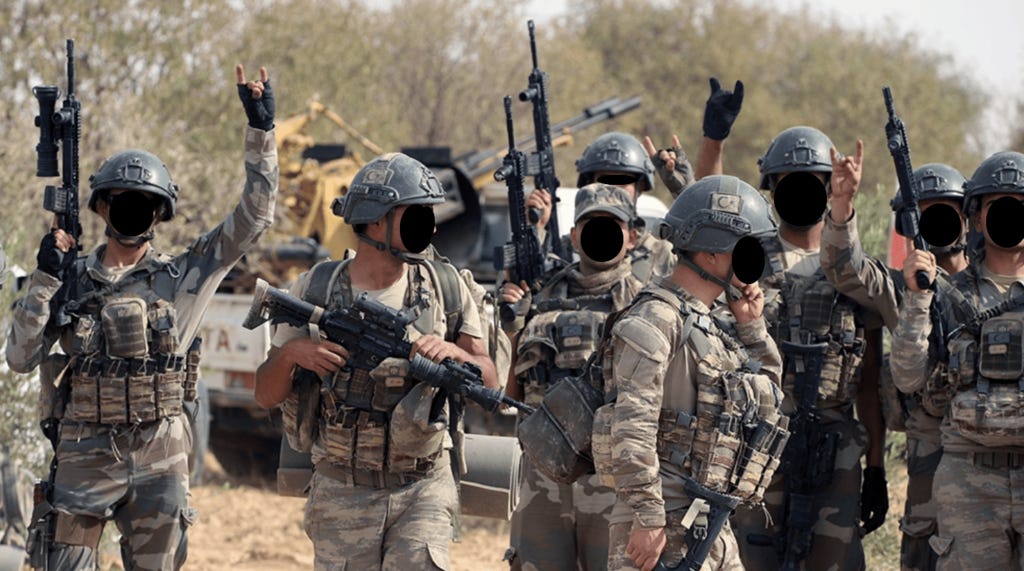
With the general retreat of American power in the aftermath of the wars in Iraq and Afghanistan, and external events outside of US control like the Arab Spring/Winter and Russia’s expansionism in the former Soviet space, security is in short supply. And as before, a “private” solution has entered the space. But this time, the private solutions, PMCs, are truly extensions of state governments. And their solution is to provide a very focused and limited sense of security for the nations that “employ” them. These nations have also gone to great lengths to muddy and obfuscate their connections to said PMCs. This is a cover and a deniability of their activities, and who is truly responsible for their actions. But as with any foreign policy tool, there are risks. And in this context of PMCs, no example is clearer than the June 2023 Wagner rebellion. Over the course of three days, heavily armed Wagner mercenaries marched from the frontlines in Ukraine towards Moscow with the intent to replace various members of the Putin regime by force. Putin found this threat real enough to deploy MoD (Ministry of Defense) Internal Security forces to the streets of Moscow. But the Wagner troops would stop and turn back before they were needed. This is, of course, an extreme example, but it is still relevant. Historically, it has never been a good idea to rely on large groups of heavily armed troops that are loyal to the state via cash payments only.
As mentioned earlier, the end of the Cold War was known by some as “the end of history”. But as the world has come to know instability and crisis that inevitably followed from the end of a bipolar world order and America’s reckless use of its unipolar moment, new security solutions needed to be found. This is how we find the modern mercenary, or PMCs, in the world today. Nation-states that found themselves on the edge of the geopolitical chessboard during the Cold War, like those in sub-Saharan Africa, were in the most dire need of new security solutions in the immediate post-Cold War years. South African-based PMCs were there to help fill the void. When America rashly decided to declare a global war on terror in the aftermath of 9/11, PMCs were there to support a multi-front war being fought by a military that had been gutted by years of budget cuts. And as general disorder crept further across the Middle East and the post-Soviet space after 2014, new nation-state-sponsored PMCs would be there to look out for their patrons’ economic interests. It’s these three waves that represent three evolutions of the PMC/“mercenary” model in the post-Cold War world. It’s truly hard to see where this trend will go, as there have been major successes and failures. Executive Outcomes was able to bring at least temporary peace to several African conflicts. But it would quickly alienate world powers with their reckless use of violence and lack of accountability. Blackwater, and others, were able to keep the US war machine running while it found itself increasingly mired in a quagmire in both Iraq and Afghanistan. But the PR turned south when images of black-clad, heavily armed ‘cowboys’ shooting Iraqi civilians became too much for a democratic nation fighting for law and order to stomach. And whereas Wagner was able to make some battlefield progress where regular Russian army units had failed, their success was empowering them to turn their guns towards Moscow. In addition, a few of the Wagner deployments on behalf of Moscow have gone quite poorly. Russian mercenaries were thoroughly bested in the jungles of Mozambique and have failed to squash Malian rebels. One could glean that as history has moved forward and technology has changed, nation-states are still struggling with how to properly address accountability and the inherent risks of using large groups of armed personnel whose only loyalty to the state comes from a bank deposit.
https://www.gisreportsonline.com/r/private-military-companies/
https://www.consilium.europa.eu/media/66700/private-military-companies-final-31-august.pdf
"The problem with mercenaries is that they need to be paid to start fighting. And, unless you are very lucky, you end up paying them even more to stop" Terry Pratchett, in Jingo, captured the problem in a single sentence.
Great commentary on the rise and fall, and rise again of the PMC’s. They are like holding an unlicensed firearm, deadly, unaccountable and morally questionable. Thanks for sharing 🤙